

 by Amit Goel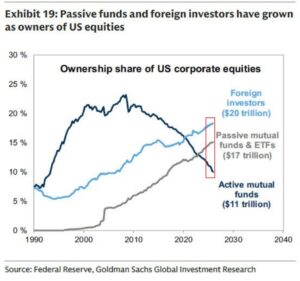
This chart highlights a structural shift in US equity ownership over the past three decades. Foreign investors and passive investment vehicles have steadily become the dominant holders of US equities, while the share owned by actively managed mutual funds has continued to decline. The growing presence of passive funds means a larger portion of capital is now allocated automatically through index-based strategies rather than active stock selection, while rising foreign ownership underscores the increasing global dependence on US financial markets. Together, these trends suggest that market performance is becoming increasingly influenced by passive capital flows and international investment, making liquidity, global sentiment, and ETF inflows more important drivers of US equity valuations than ever before.
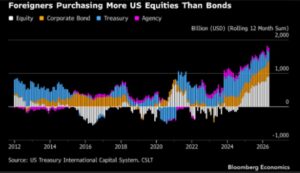
This chart builds on the previous trend by showing that foreign investors are increasingly directing new capital toward US equities rather than fixed-income securities. Recent inflows into US stocks have significantly outpaced purchases of Treasuries and corporate bonds, reflecting a stronger preference for equity exposure despite elevated interest rates. Together with the previous charts, this suggests that sustained foreign demand has become a key source of support for US equity markets. However, it also increases the market’s dependence on continued international capital inflows, meaning any reversal in global risk appetite or cross-border investment flows could have a disproportionate impact on US equity valuations and overall market liquidity.
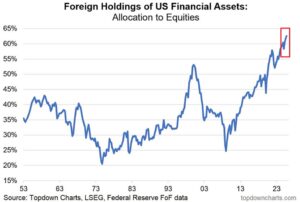
This chart completes the picture by showing that foreign investors are committing an increasingly larger share of their US portfolios to equities, with allocations reaching a record high. Rather than simply increasing exposure, overseas investors are concentrating their investments in the US stock market, reflecting a growing preference for its superior earnings growth, market depth, and leadership in innovation. Together, all three charts suggest that foreign capital has become a critical driver of US equity valuations. While this reinforces the market’s current strength, it also implies that any shift in global asset allocation or deterioration in international investor confidence could have an outsized impact on US equity performance and market resilience.
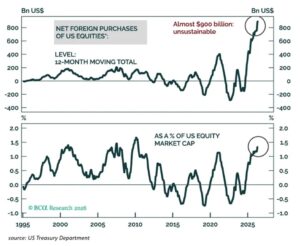
This chart strengthens the previous analysis by showing that foreign demand for US equities has accelerated to unprecedented levels, with net purchases approaching $900 billion on a 12-month basis, the highest level on record. Relative to the size of the US equity market, foreign buying has also climbed to one of its strongest levels in decades, highlighting the exceptional pace of international capital inflows. This suggests that recent market gains are being increasingly reinforced by external demand rather than domestic participation alone. While these inflows continue to provide strong support for US equity valuations and liquidity, the current pace appears historically elevated, raising questions about how sustainable such buying can remain over the longer term if global growth, earnings expectations, or investor sentiment begin to weaken.
Conclusion
Taken together, these three charts suggest that the US equity market is becoming increasingly reliant on foreign capital, with overseas investors playing a larger role in supporting valuations and market liquidity. If this trend continues, market concentration among foreign investors is likely to increase further, reinforcing the dominance of US equities in global portfolios. However, this dependence also creates a key macro risk: any meaningful correction in US equities, deterioration in economic growth, or shift in global risk sentiment could lead to slower foreign inflows or portfolio reallocation, amplifying market volatility. As a result, the sustainability of future market gains will increasingly depend on continued earnings growth, economic resilience, and the ability of the US to remain the preferred destination for global capital.If history is any indication, this trend will peak out at some point in near future making US and consequently the global equities extremely vulnerable some time probably in the next 1 year.