
 by Amit Goel
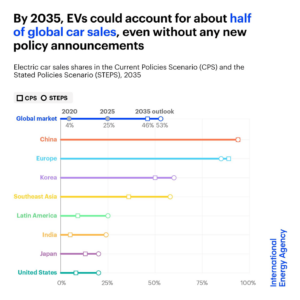
China already sells more electric cars than combustion ones, and Europe is not far behind, while the United States, Japan, and India remain well under 25%. The headline number that ties the whole picture together sits in the global-market row at the top: even under the IEA’s more conservative scenario, which assumes no government anywhere announces a single new EV incentive, subsidy, or emissions rule between now and 2035, electric cars still end up taking roughly half of global sales. That is a striking claim precisely because it removes policy as the explanation and leaves cost and consumer preference to do all the work.
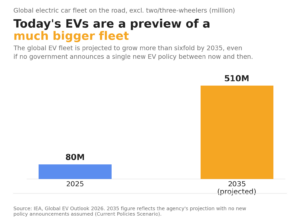
Sales share is a flow; the fleet on the road is the stock that flows up over time, and that is where the scale of this shift becomes concrete. Roughly 80 million electric cars are on the road worldwide today. The IEA expects that number to reach 510 million by 2035, more than six times larger, without needing sales share to rise beyond what Exhibit 1 already shows. Every year that passes with EVs anywhere near a quarter or more of new sales adds compounding weight to a fleet that essentially never shrinks, since cars stay on the road for a decade or more after purchase.
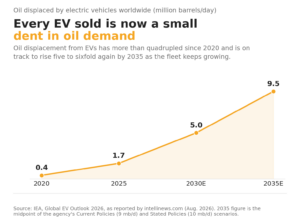
A fleet six times larger has an energy-market footprint to match. Oil displacement from EVs has already gone from 0.4 million barrels a day in 2020 to 1.7 million barrels a day in 2025, and IEA projections put it near 9 to 10 million barrels a day by 2035, edging close to what a mid-sized OPEC producer pumps today. The timing has its own irony: this year’s oil-price shock, driven by conflict in the Middle East, is pushing more households and fleet buyers toward EVs to escape volatile fuel costs, which means the disruption to oil markets is now partly self-reinforcing rather than something EVs alone are causing from the outside.
Conclusion
The three charts trace a single mechanism at three different time horizons: which markets are converting to EVs fastest right now, how large the resulting fleet becomes over the next decade, and what that fleet does to global oil demand once it is fully on the road. None of this depended on optimistic assumptions; the IEA’s baseline explicitly holds policy support flat, and the growth still shows up. For energy markets, that reframes the current oil-price spike less as a one-off shock and more as an accelerant on a transition that was already underway, pulling forward EV adoption that might otherwise have taken years longer to reach the same scale. For an economy where global bond markets and central-bank decisions have spent much of 2026 reacting to oil-driven inflation, a car market quietly capable of removing several million barrels a day of demand within a decade is a variable worth tracking alongside the ones already getting the headlines.