
 by Amit Goel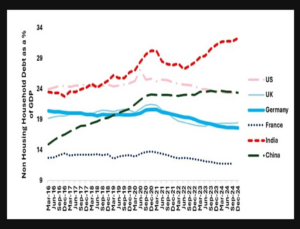
This chart strips out mortgages and looks only at non-housing household debt as a share of GDP across major economies. On this specific measure, India sits above the US, UK, Germany, France, and even China, and the trend line has been rising sharply since 2020, briefly dipping before resuming its climb through 2024. This is a meaningfully different picture from the one usually presented about Indian household debt, where India is often described as under-leveraged relative to developed economies. That comparison typically includes mortgage debt, where India genuinely does lag due to lower home-ownership financing penetration. Once housing is removed from the picture, the ranking flips entirely — India is not catching up to the rest of the world on non-mortgage borrowing, it is leading it.
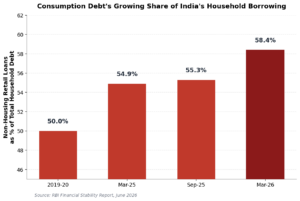
The first chart shows how much non-housing debt Indian households are carrying. This chart shows what that debt is increasingly made of. A steadily rising share of household borrowing is now non-housing retail credit — personal loans, credit cards, consumer durable financing, and gold loans — moving into debtlargely to fund day-to-day consumption. This is not a one-off spike but a clear multi-year shift in the character of Indian household borrowing. RBI data adds a sharper edge to this trend, showing that these non-housing retail loans now account for many fresh bad loans in the system, while gold loan borrowing has surged dramatically over recent years as households increasingly pledge jewelry to access short-term liquidity.
Conclusion
The mechanics behind this are straightforward but concerning. Wage growth for a large section of Indian households has not kept pace with the cost of living, and easier access to digital credit, NBFC lending, and buy-now-pay-later style products has filled that gap with borrowed money rather than earned income. This stress is concentrated precisely among those with the least capacity to absorb a shock, since lower-income borrowers hold the highest share of unsecured loans, while household savings have simultaneously fallen to some of the lowest levels in years, thinning the very buffer that once stood between families and financial distress. A rising debt burden is manageable when it funds productive or asset-building activity and borrowers have income growth to fall back on — what the data instead shows is debt increasingly built on consumption, concentrated among those least equipped to handle it, and already surfacing as a disproportionate share of new bad loans. None of this yet registers as a crisis in the headline figures, but it is precisely the kind of shift in composition that tends to surface well before the aggregate numbers catch up.