
 by Amit Goel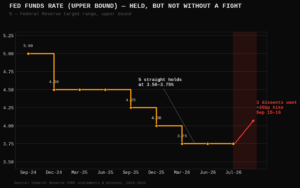
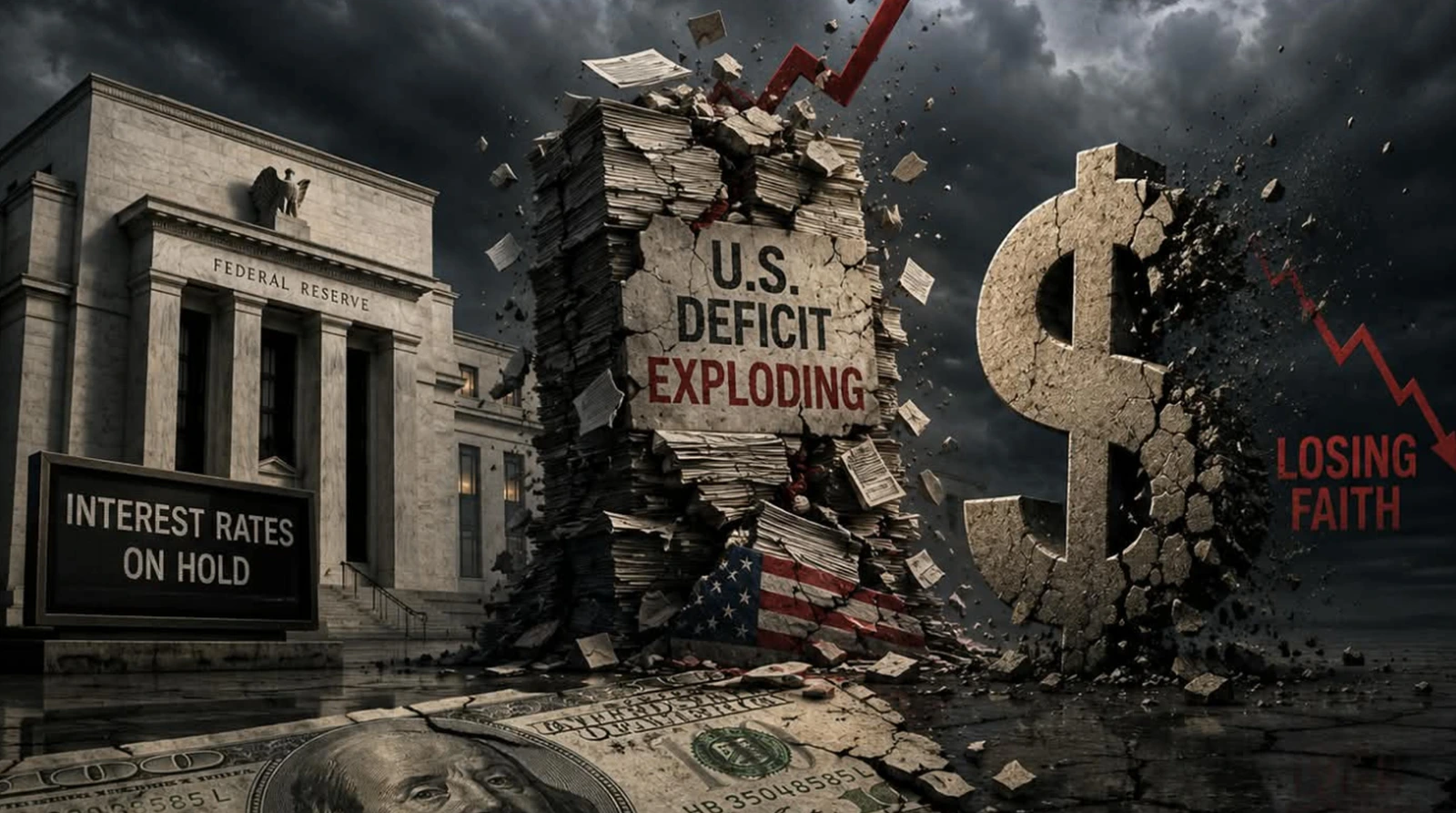
After cutting from 5.00% down to 3.75% through late 2024 and into 2025, the Federal Reserve has now held its target range at 3.50–3.75% for five consecutive meetings through July 2026. That stability is deceptive. Three FOMC members dissented at the July meeting, preferring an immediate 25 basis point hike, and the Fed’s own June dot plot showed nine members projecting at least one hike before year-end versus just one projecting a cut. Inflation remains above the 2% target, driven in part by an energy-price shock, while job growth has simultaneously slowed to a near-standstill level, leaving the Committee genuinely split on which risk to fight. The next meeting, September 15–16, is a real, live decision point, not a formality.
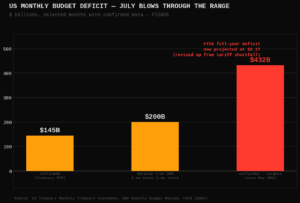
While the Fed debates whether inflation risk still justifies higher rates, the fiscal side of the picture has quietly gotten worse. The US government posted a $432.3 billion deficit in July 2026 alone — the largest single-month shortfall since March 2021 — and the Congressional Budget Office has revised its full-year FY2026 deficit projection up to $2.1 trillion, citing lower-than-expected tariff revenue after a Supreme Court ruling narrowed the government’s tariff authority. A central bank trying to hold rates high enough to fight inflation is now doing so against a Treasury borrowing at a faster pace than at almost any point outside the pandemic response — two policy arms pulling in opposite directions at the same time.
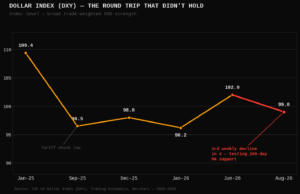
This is where the signal becomes hard to ignore. The dollar index collapsed from 109.4 in January 2025 to a tariff-shock low near 96.5 by September 2025, then staged a genuine recovery back to roughly 102 by mid-2026 as rate-cut expectations faded. Since then, it has round-tripped straight back down to 99 — its third weekly decline in four, now testing key technical support below its declining 200-day moving average. Normally, a Fed that is holding rates and facing internal pressure to hike would support the currency, not weaken it. The fact that the dollar is falling anyway, at the same time long-dated Treasury yields have been rising (on debt-sustainability concerns), points to something more specific than routine volatility: markets pricing in doubts about US fiscal credibility itself, not just the next rate decision.
Conclusion —
Individually, a paused Fed, large fiscal deficit, and weaker dollar are manageable, but their combination points to growing concerns over US policy credibility. With inflation still elevated, the Fed has limited room to ease, while heavy government borrowing adds pressure on long-term yields and fiscal sustainability. The key near-term focus is the September 15–16 FOMC meeting, where either a hawkish hold or surprise hike could keep rate and currency volatility elevated. Meanwhile, the resilience of equities contrasts with growing stress in bonds and the dollar. We believe that the long-term bond yields may go up yet again before they start coming down. The equities may continue to ignore the warning signals from the rates and currency markets for now as the AI bubble continues to grow bigger before its eventual deflation.