

 by Amit Goel
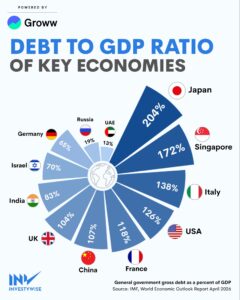
The first chart highlights a growing concentration of fiscal pressure across some of the world’s largest economies. What is particularly concerning is that several major economies are entering the next phase of the economic cycle with limited fiscal room to respond to another recession, financial shock, or geopolitical disruption. High government debt also makes these economies more sensitive to changes in bond yields, as higher borrowing costs can gradually increase interest expenses and divert government resources away from productive spending. This creates a difficult policy trade-off: governments may need to support growth during periods of weakness while simultaneously maintaining fiscal discipline and keeping inflation under control. The risk therefore extends beyond government balance sheets — persistent fiscal pressure can increasingly influence bond markets, currencies, private-sector borrowing costs and overall investor confidence.
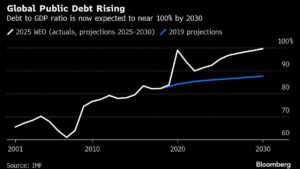
The second chart shows that the bigger story is not just where debt stands today, but how dramatic expectations for future debt have changed. Before the pandemic, the IMF’s 2019 projections suggested that global public debt would remain around the mid-80% range of GDP by 2030. The latest trajectory instead points toward almost 100% of GDP by 2030. The sharp jump around 2020 reflects the extraordinary fiscal response to the pandemic, but the important development is what happened afterwards: rather than returning to the previous projected path, global debt remained structurally higher and continued to rise. In other words, the pandemic did not simply create a temporary increase in borrowing money, it appears to have shifted the baseline for government indebtedness to a permanently higher level. This leaves future governments facing a more difficult trade-off between supporting economic activity, managing inflation and maintaining fiscal credibility.
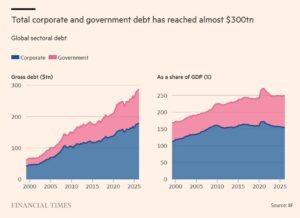
The debt burden extends beyond governments into the corporate sector, creating a broader leverage problem across the global economy. The rise in combined corporate and government debt means that changes in financing conditions can increasingly affect both public and private balance sheets at the same time. For companies, higher borrowing costs can raise refinancing expenses and reduce the incentive to invest, while weaker earnings can make existing debt harder to service. This becomes particularly important during periods of slower growth, when corporate cash flows can weaken just as lenders become more selective. The result is a stronger link between bond-market conditions, corporate investment and economic activity, making the global debt cycle increasingly important for financial markets.
Conclusion
Put together, the three charts show that the global debt challenge is becoming broader, deeper and more interconnected. Government debt is already elevated across major economies, the long-term global debt trajectory has moved materially higher than pre-pandemic expectations, and corporate borrowing adds another layer of leverage to the system. The key concern is therefore not simply the size of debt, but the economy’s ability to service, refinance and grow around that debt. As corporate debt accumulates, the burden of compound interest and refinancing costs can gradually increase, reducing cash flows available for investment, expansion and productivity growth. If growth remains strong and financing conditions are easy, the burden can remain manageable; however, a combination of slower growth and persistently high borrowing costs could expose vulnerabilities across governments, companies and financial markets, making debt sustainability an increasingly important macro risk.