
 by Amit Goel
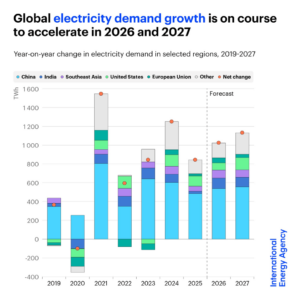
After cooling from 2024’s net increase of roughly 1,250 terawatt-hours to about 850 terawatt-hours in 2025, global electricity demand growth is forecast to reaccelerate to just over 1,000 terawatt-hours in 2026 and above 1,100 in 2027. That reversal matters because electricity demand had spent decades growing slowly and predictably in most developed economies; a renewed acceleration after a down year signals a new source of demand has entered the picture rather than a simple rebound in the old ones. China still supplies the largest single bar in every year shown, but the forecast period is the first stretch where the United States and European Union segments grow noticeably alongside it rather than trailing behind.
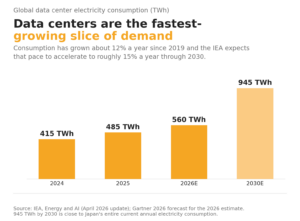
That new source is largely data centers. Global consumption has already gone from 415 terawatt-hours in 2024 to an estimated 485 in 2025, and the IEA’s April 2026 update puts the 2030 figure at roughly 945 terawatt-hours, an amount close to Japan’s entire annual electricity use today. The growth rate itself is what should concern anyone reading Exhibit 1: data center demand grew about 12% a year from 2019 to 2024, a pace the IEA now expects to accelerate toward 15% a year through the end of the decade, driven almost entirely by AI workloads running on accelerated servers rather than the conventional computing load data centers carried a decade ago.
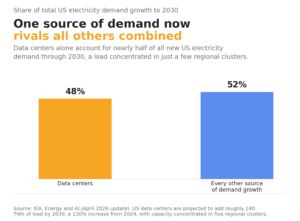
The concentration is sharper than the global totals suggest. In the United States, data centers alone are projected to account for nearly half of all new electricity demand through 2030, adding roughly 240 terawatt-hours of load, a 130% increase from 2024 levels. Nearly half of that capacity sits in just five regional clusters, which means the strain on transmission lines, substations, and generation falls on a handful of grids rather than spreading evenly across the country. The United States and China together are expected to supply close to 80% of the entire world’s data center demand growth, so the regions carrying Exhibit 1’s steepest bars are, not coincidentally, the same regions absorbing most of this new load.
Conclusion
Put the three exhibits together and the vulnerability is structural rather than hypothetical. Electricity demand growth is reaccelerating at the system level, data centers are growing faster than any other category of demand and are on pace to double again by 2030, and nearly half of the US increase is concentrated in a handful of grids rather than distributed broadly. Utilities plan and build generation and transmission on timelines measured in years, while AI infrastructure is being committed on timelines measured in quarters, and that mismatch is already showing up as interconnection queue delays, deferred coal-plant retirements, and rising demand for new gas turbines in the regions nearest the largest clusters. If the AI build-out keeps compounding at anything close to its recent pace, the near-term risk is not a slow, manageable rise in power prices but a series of localized capacity crunches in the exact regions where both data centers and ordinary households are competing for the same scarce megawatts.