

 by Amit Goel
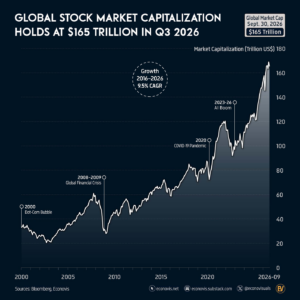
Global equity market capitalization ended the third quarter at $165 trillion, compounding at 9.5% a year over the past decade. The shape of the line matters as much as the level: each setback marked on the chart, from the dot-com bust to the financial crisis, the pandemic, and the 2022 reset, was followed by a higher high. The climb out of the 2022 low near $92 trillion has added roughly $73 trillion in under four years, more than twice the entire world market at its 2009 trough. Earlier this year the total also gave back about 8% from a peak near $158 trillion and recovered within months, which is the kind of speed that teaches investors to treat every dip as temporary.
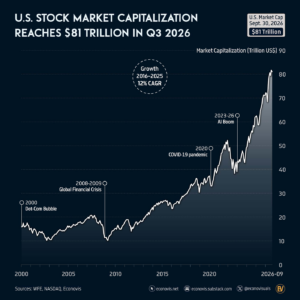
The US stock market has grown faster than the rest of the world, and its weight in global market value is now back to where it stood at the dot-com peak. Since the late-2022 lows, American shares have supplied most of the world’s gains, so global equity performance now depends heavily on one market. That concentration is meeting a harder backdrop. Higher yields matter because they make future corporate profits worth less today, which puts the most pressure on stocks that were bid up for growth. The rally is also narrow: the main indexes are well up for the year, but the typical stock has barely moved, so a small group of large companies is carrying the headline numbers. Because the US now makes up such a large share of world market value, no other market is big enough to offset a US-led decline, which makes the coming earnings season and the Fed’s next decision important for global investors, not just American ones.
Conclusion
The two charts describe a market that has become both bigger and more dependent on a single region. Global equity wealth has grown nearly sixfold since the 2009 low, but a growing share of it sits in US shares, and within the US a growing share of the return sits in a narrow group of technology leaders. The early-2026 pullback shows why that matters: the global total fell about 8% while the US fell closer to 5%, which means the US acted as the cushion for everyone else. That cushion works only while the shock comes from somewhere else. This time the pressure points are domestic, with US inflation, US yields, and US AI valuations all in play at once, and with the United States at nearly half of world market value there is no equally large market left to absorb a US-led decline. The earnings season is now under way and the Fed’s October decision is the next tests of whether profit growth can keep outrunning the cost of money.