

 by Amit Goel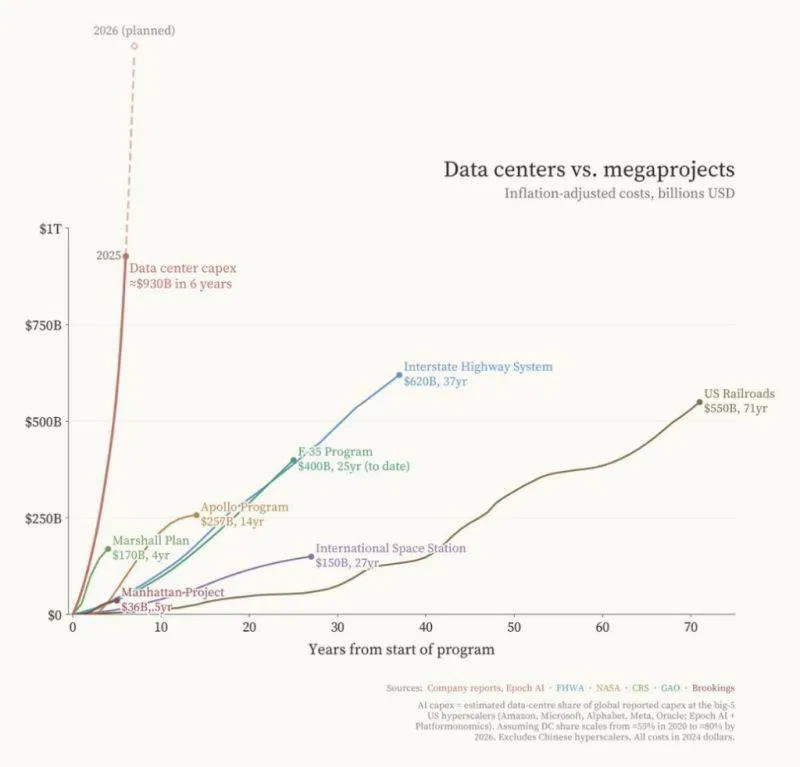
This chart highlights that the ongoing AI-driven data center buildout is evolving into one of the largest capital projects in modern history. In just six years, global data center capex has already approached $930 billion, surpassing or matching the inflation-adjusted costs of many historic megaprojects such as the Apollo Program, the Interstate Highway System, the F-35 program, and even the entire US railroad network, which took decades to build. Unlike previous projects that unfolded over several decades, data center spending is accelerating at an unprecedented pace, driven by AI, cloud computing, and the enormous demand for computing power. If current trends continue, the planned 2026 spending trajectory suggests that AI infrastructure could become the most expensive and fastest-growing megaproject ever undertaken, potentially breaking historical records and reshaping the global economy much like railroads, highways, and electrification did in previous eras.
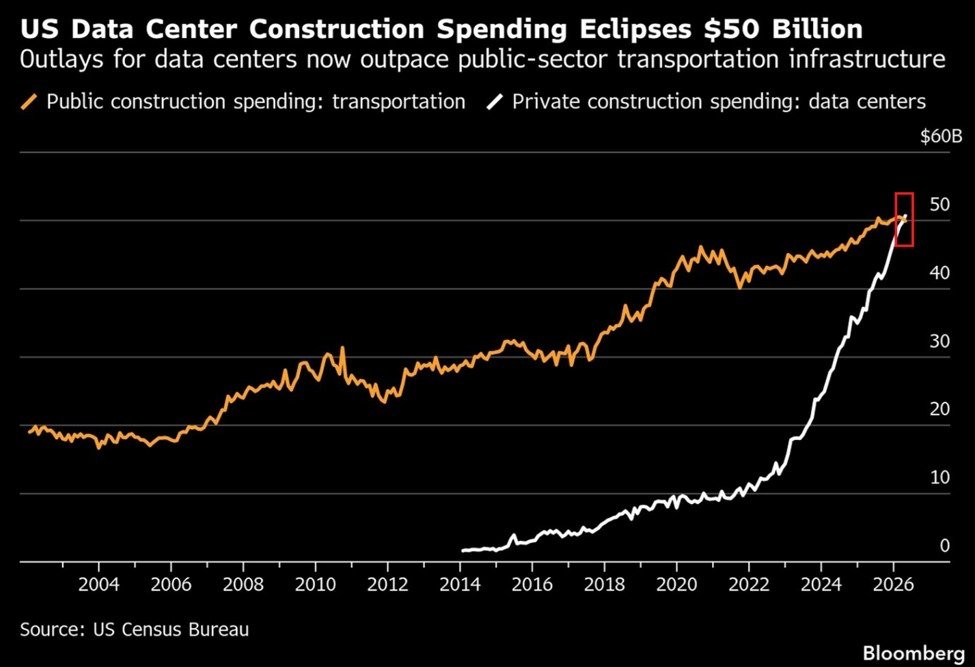
This chart reinforces the previous data-center spending trend by showing just how dominant AI infrastructure investment has become within the broader economy. While the earlier chart highlighted the explosive growth in data-center construction, this chart reveals that private spending on data centers has now surpassed public-sector transportation infrastructure spending, a category that has historically been one of the largest areas of capital investment. This marks a significant shift in economic priorities, where digital infrastructure is becoming as important as traditional physical infrastructure.
The crossover suggests that AI is no longer simply a technology trend but a major driver of capital allocation across the economy. Companies are investing at an unprecedented pace to expand computing capacity, power networks, and cloud infrastructure needed to support growing AI demand. In the current environment, the fact that data-center spending now exceeds transportation infrastructure spending highlights the scale of the AI buildout and underscores how digital infrastructure is increasingly becoming a foundational pillar of future economic growth, productivity, and investment activity.
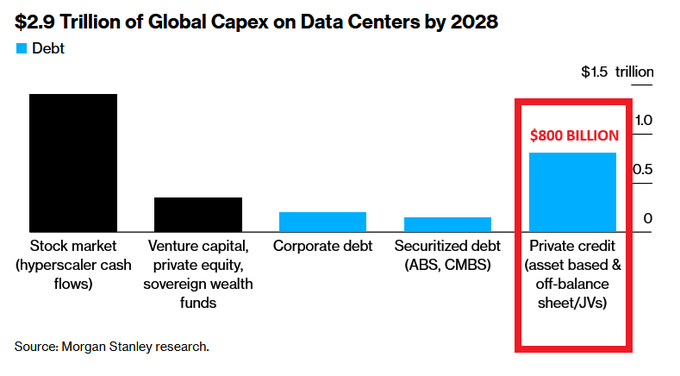
This chart reinforces the rapid rise in AI-driven data-center construction by showing that the projected $2.9 trillion of global capex by 2028 will be funded not only by hyperscale cash flows and equity markets, but increasingly through debt and private credit. If capital continues to flow, construction spending could accelerate further, supporting sectors such as semiconductors, power, and industrials. However, the growing dependence on debt financing means that any slowdown in AI spending, tighter financial conditions, or weakness in equity markets could quickly reduce funding availability, causing construction growth to slow and create broader ripple effects across the economy and financial markets.
Conclusion
Taken together, these charts indicate that AI has evolved into a foundational pillar of the current economic cycle, with an increasing number of industries and market participants becoming tied to the continuation of this investment wave. This growing concentration means that sustained capital deployment could continue to strengthen technological leadership and support broader economic momentum. However, it also implies that any moderation in spending would likely be felt far beyond the technology sector, potentially affecting supply chains, industrial activity, employment, and market sentiment, making the global economy and financial markets increasingly sensitive to the trajectory of AI investment.