

 by Amit Goel
The Center of Global Influence
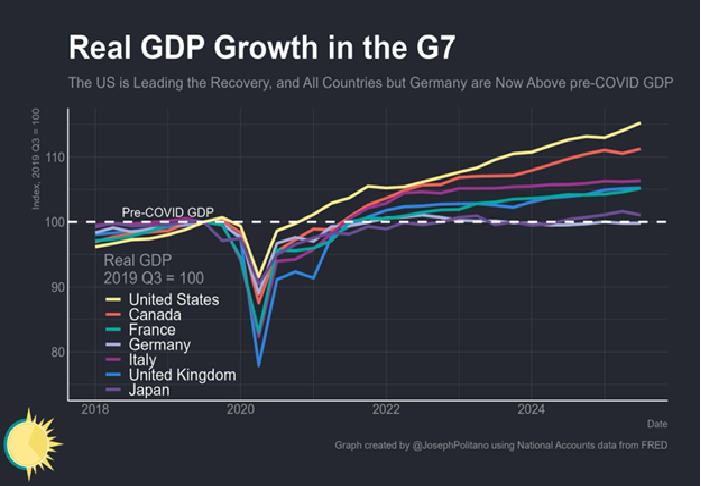
This chart illustrates how G7 economies have emerged from the pandemic with output levels firmly above their pre-COVID benchmarks, reinforcing the dominance of developed markets in the global recovery. The United States leads the expansion, while Canada, France, the UK, Italy, and Japan show steady, sustained progress, reflecting the resilience of advanced economic systems. Germany remains the outlier, constrained by structural and energy-related challenges, yet still maintaining stability rather than experiencing prolonged contraction.
A critical but often underappreciated driver behind this performance is currency strength. Relative appreciation in developed-market currencies has reinforced growth by lowering imported inflation, stabilizing capital flows, and attracting global investment. Stronger currencies have enhanced real purchasing power, supported domestic demand, and amplified the effectiveness of fiscal and monetary policies. Together, resilient growth and currency appreciation highlight how developed economies continue to set the pace for global expansion, concentrating on economic influence, capital dominance, and policy leadership in the advanced world. Combined with credible policy frameworks, fiscal flexibility, and institutional strength, these economies remain well-positioned to keep contributing disproportionately to global growth. Their ability to deploy policy support, attract investment, and stabilize economic cycles ensures that developed markets continue to anchor global economic momentum in the post Covid era.
Conclusion
The global landscape has consistently placed the G7 in a position of outsized influence that extends beyond headline economic growth. Historically and through the present cycle, their scale, technological leadership, depth of financial markets, and control over key global institutions have allowed them to shape trade flows, capital allocation, and policy norms worldwide. This concentration of economic and financial power has enabled the G7 to set the tone for global cycles, absorb shocks more effectively, and preserve strategic influence within the global order.
In the current macro environment—marked by elevated geopolitical risk, fragmented supply chains, and uneven global growth—the G7’s dominance has become even more visible. Tight control over global liquidity, leadership in technology and capital markets, and coordinated policy actions have provided these economies with a clear advantage in navigating volatility. As inflation pressures, energy security concerns, and geopolitical realignments have reshaped the global economy, the G7 has continued to convert uncertainty into strategic leverage, reinforcing its central role in global growth dynamics and financial stability.



Comments are closed.