

 by Amit Goel
Markets Absorb Crises — And Still Climb to New Highs.
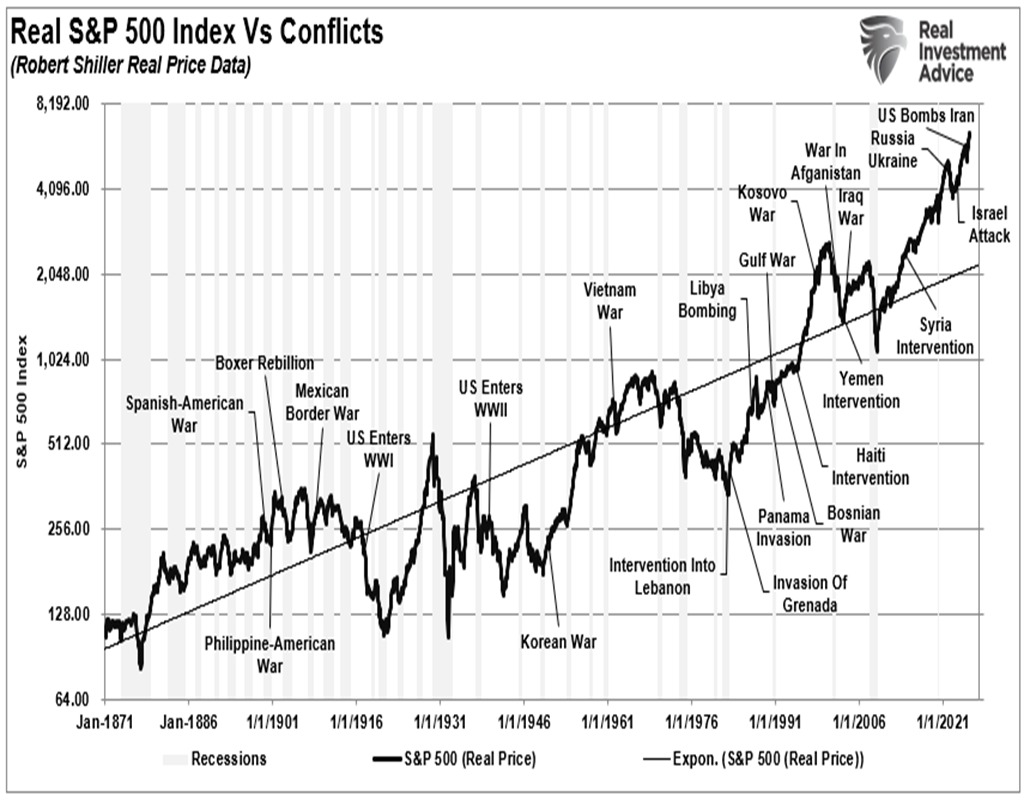
The long-term trajectory of the S&P 500 reveals a powerful structural pattern: despite repeated geopolitical disruptions—including major wars and global conflicts, the index has maintained a persistent upward trend for over more than a century. Events such as the World War I, World War II, the Korean War, the Vietnam War, and more recent tensions like the Russia–Ukraine War initially triggered volatility and temporary drawdowns, but markets consistently rebounded and continued their broader expansion. This pattern highlights that while geopolitical shocks create short-term uncertainty and risk aversion, they rarely alter the long-term trajectory of economic growth and corporate earnings. Over time, technological progress, capital formation, and productivity gains have outweighed the negative effects of conflicts. The chart therefore illustrates a key macro insight: geopolitical crises tend to produce short-lived market disruptions rather than permanent structural declines, and historically they have often been followed by strong recoveries as investors refocus on long-term growth fundamentals.
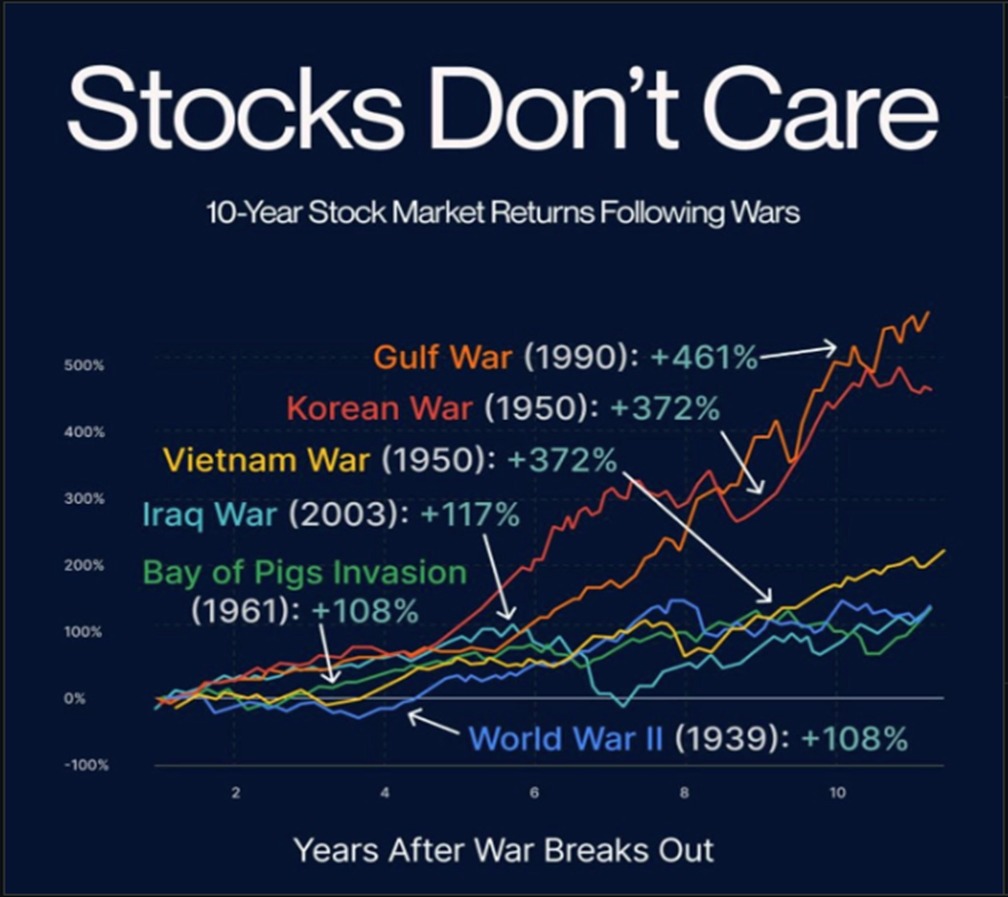
When this chart is correlated with the long-term trajectory of the S&P 500 shown earlier, it highlights a consistent investment pattern: periods of geopolitical stress tend to generate short-term volatility, but they rarely interrupt the structural compounding power of equities. The data shows that even when markets initially react with uncertainty, capital gradually returns as economic activity stabilizes, corporate earnings recover, and liquidity conditions normalize. Over time, productivity growth, technological innovation, and expanding global consumption continue to drive corporate profitability, allowing equities to resume their broader upward trajectory. As a result, major indices have historically absorbed temporary disruptions, moved through phases of consolidation, and eventually advanced to new record highs. This reinforces an important long-term investment principle: investors who focus on strong fundamentals and maintain long-term exposure are more likely to benefit from the market’s compounding effect, rather than being distracted by short-term turbulence that often proves temporary in the broader cycle.
Conclusion
Taken together, the broader historical trend and the post-conflict performance patterns reinforce a key long-term investment principle in the S&P 500: equity markets tend to reward patience far more than short-term timing. Temporary corrections and uncertainty phases often create periods of mispricing, allowing disciplined investors to gradually accumulate quality assets at better valuations. Rather than reacting to every headline-driven fluctuation, a long-term approach focused on fundamentally strong companies allows investors to benefit from the compounding effect of earnings growth over time. In this context, market pullbacks are less of a sign of structural weakness and more an opportunity to deploy additional capital strategically, positioning portfolios to capture the long-term wealth creation that equities have historically delivered.
Macro Implications
The broader implication for investors is that market behavior during periods of global uncertainty often creates phases of elevated volatility and risk repricing, which can temporarily distort valuations across asset classes. For long-term participants in the S&P 500, this environment typically favors strategies centered on asset allocation discipline, diversification, and systematic investing rather than reactive trading. As capital flows gradually return once uncertainty stabilizes, sectors tied to structural growth—such as technology, infrastructure, and energy transition—often regain leadership and drive the next market expansion phase. Therefore, maintaining strategic exposure to equities while using volatility to rebalance portfolios can help investors align with the broader cycle of economic expansion and capital appreciation that historically underpins long-term market performance.



Comments are closed.