
 by Amit Goel
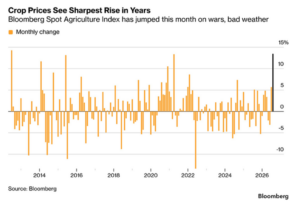
This chart tracks the monthly change in the Bloomberg Agriculture Spot Index, which follows ten major crop products. August 2026 stands out sharply from everything around it: the index climbed more than 13% for the month, the steepest single-month gain since July 2012 — fourteen years ago. Prices had already peaked once in May, when the Iran conflict disrupted fertilizer and fuel shipments, before that risk premium briefly faded in June. What’s happening now is a fresh, separate spike, driven by escalating attacks on Black Sea ports choking off grain exports from one of the world’s most important growing regions, combined with a strengthening El Niño and summer heat waves that damaged corn crops across the US and Europe. This is not a continuation of an old story — it is a new shock layering on top of one that had only just started to fade.
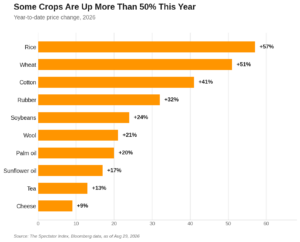
The aggregate index in Exhibit 1 hides just how extreme individual crop moves have been this year. Rice and wheat are the two biggest movers by far — are both staples that a large share of the world’s population depends on directly for calories, not discretionary consumption. Cotton, rubber, and soybeans have all seen sharp gains as well, and even the smallest mover on the list has still moved meaningfully higher. Corn is up 28.89% year-on-year. Wheat’s surge traces directly to the Black Sea port attacks referenced in the first chart, while sugar’s jump is being driven by tight stockpiles in India ahead of festival-season demand. These are not speculative or luxury commodities moving on sentiment; they are staple foods and industrial inputs moving on physical supply disruption — which is exactly what makes this concerning rather than routine, since prices driven by broken supply chains tend to take much longer to unwind than prices driven by speculation.
Conclusion
Put together, these two charts describe a situation where crop prices are not just higher than usual — they are rising at a pace inflation has struggled to outrun, with the largest monthly move in fourteen years hitting at the same time some of the world’s most consumed staples are up more than half their value in under a year. This isn’t a single, resolvable shock either — war-driven disruption to shipping and fertilizer is compounding with heat-driven yield damage that, by most current estimates, is now expected to be the more persistent driver going into 2027, since weather affects harvests directly and repeatedly while war-related disruption moves through the system more slowly. That means food inflation here isn’t a lagging, backward-looking statistic but something running in near real-time alongside the commodity moves themselves, pointing to grocery bills, menus, and packaged food costs staying elevated for some time, with staples rather than luxury items absorbing the brunt of it.